الاثنين، 5 ديسمبر 2011

Bitter Melon (Bitter Gourd) Sambar

bitter gourd

May the fruit of the bitter gourd reside in every morsel of mine
~ from "Kshema Kutuhalam", an ancient Ayurvedic text as quoted by Jigyasa Giri and Pratibha Jain

If you've grown up in North America, there's a very good chance that you've never eaten bitter melons, if in fact you've even heard of them — and that would be a shame. Also known as bitter gourds, bitter melons have a fresh crunch that tastes like something between zucchini and cucumber — except, of course, far more bitter. But while deserving of their name, bitter melons are also powerhouses of nutritional and healing benefits that are highly esteemed in India and much of Asia, where the vegetable is considered a tonic for stomach complaints and the listless appetites of the elderly and the sick. Also considered to have anti-viral, anti-anemic and even anti-diabetic properties, you don't need to be suffering any maladies to enjoy a rich source of iron, beta carotene, calcium and potassium and good source of fiber, phosphorus and vitamins A, B1, B2, B3 and C that should give bitter melons a prominent place in any nutritionist's dossier.

Fortunately, bitter melons are also widely available here in any Indian or Chinese grocer, and the bitter taste — difficult to acquire on its own — is easily moderated by cooking with rich and spicy flavors as in this hearty and colorful sambar, adapted from Chandra Padmanabhan's delightful compendium of South Indian cooking "Dakshin". Served with every South Indian meal, sambars are vegetable stews cooked with toor dal (pigeon peas) and flavored with tamarind and ground spices — bitter melons perform an admirable contrast with these rich tastes and make an astoundingly flavourful dish that is delicious served with hot freshly cooked rice.

bitter melon sambar

As with toor dal, tamarind, jaggery and other ingredients in this recipe, bitter melons are easily found in Indian and Asian grocers. The immature fruits of a vine plant, Indian bitter melons are not difficult to identify by appearance — short green oval gourds with a skin covered with "warts" and ridges. Chinese bitter melons have a paler and less stippled appearance — either variety can be used, and first comers may want to consider that Chinese bitter melons are a little less bitter in taste. Avoid bitter melons that are starting to turn yellow — these should be discarded — and refrigerate in a plastic bag no more than a few days before cutting and using. Gently wash the skins of the gourds, cut off the ends, and slice lengthwise to scrape out the seeds and fibrous tissue before chopping and cooking.

One further note — good commercial brands of sambar masala or sambar powder are also easily available at Indian grocers, but to get the vibrancy of a spice blend made fresh at home, just follow this very simple recipe here.

Bitter Melon (Bitter Gourd) SambarBitter Melon (Bitter Gourd) Sambar
Recipe by
Adapted from Dakshin
Cuisine: Indian
Published on December 5, 2011

A spicy and very healthy South Indian curry made with bitter melons, one of the most extraordinary and beneficial vegetables

Print this recipePrint this recipe

Ingredients:
  • 1/2 cup toor dal
  • 3 tablespoons tamarind paste
  • 1/2 cup raw cashews, dry roasted
  • 2 cups finely chopped bitter melon (2-3 bitter melons)
  • 1 teaspoon sea salt
  • 2 teaspoons sambar powder
  • 1 teaspoon turmeric
  • 2 teaspoons jaggery or brown sugar
  • 1 large tomato, finely chopped
  • 3 cups water
For the paste:
  • 1/4 cup fresh grated coconut
  • 2 teaspoons ghee or olive oil
  • 6 dried whole red chilies, broken into pieces
  • 1 tablespoon coriander seeds
  • 1/2 teaspoon black peppercorns
  • 1 teaspoon chana dal, rinsed
  • 1 teaspoon urad dal, rinsed
  • 1/2 teaspoon asafoetida
For the tempering:
  • 2 teaspoons olive oil
  • 1 teaspoon brown mustard seeds
  • generous handful of dried curry leaves
Finish:
  • 1/2 cup coconut milk
Instructions:
  • Rinse the toor dal thoroughly and soak for 30 minutes in 2 cups of hot water. Place the toor dal and the soaking water in a medium heavy bottomed pot, bring to a boil, reduce the heat to medium low, and cover and simmer until the dal is soft, about 30 minutes. Remove from heat and set aside without draining.

  • Meanwhile, prepare the coconut. Drain the coconut water by punching holes in the sides of a fresh coconut and set aside. Now split open the coconut and grate it into a small bowl.

  • Now make the paste. Heat the ghee or oil in a skillet over medium heat. When hot, add the dried red chilies, coriander seeds, peppercorns, chana dal, urad dal and asafoetida, and fry for a few minutes, stirring frequently, until the mixture is fragrant. Remove the mixture to a blender or food processor (or my favored Magic Bullet), add the grated coconut, and process until it forms a grainy paste.

  • In a heavy-bottomed pot, heat 1 cup of water over medium heat. When hot, add the tamarind paste, chopped bitter melon, salt, sambar powder, turmeric and jaggery (or brown sugar). Cover and simmer over low heat, stirring frequently, until the bitter melon is soft and tender, about 15 minutes. Add the paste and tomato and simmer for another few minutes. Now add the undrained toor dal and continue to simmer, adding more water as desired.

  • While this mixture is simmering, prepare the tempering. Heat the oil in a small saucepan over medium heat. When hot, toss in the mustard seeds and cook until they turn grey and begin to splutter and pop. Toss in the curry leaves, stir, and add to the sambar. Simmer for a few more minutes and add 1/2 cup of the reserved coconut water just before serving. If too dry, add some extra coconut water to achieve your desired consistency.

  • Garnish with the roasted cashews and serve with naan bread or rice.

Makes 4 to 5 servings
Other South Indian sambar recipes from Lisa's Kitchen:
Homemade Sambar Masala Powder
Butternut Squash Sambar
Carrot Sambar
Black-Eyed Pea Sambar

On the top of the reading stack: Healthy Eating Healthy World
by J Morris Hicks

Audio Accompaniment: silence

السبت، 3 ديسمبر 2011

Tropical Fruit Christmas Fruitcake


Dark, rich, chewy and moist, this may be the best Christmas fruitcake you've ever had — I can say it's by far and away the tastiest I've ever eaten. I've never been very enthusiastic about the store-bought fruitcakes that are always passed around at Christmas — loaded with sickly sweet and artificially-preserved sticky fruit bits, and usually dry by the time they're cut, they seem to fail on the promise that a rich dried-fruit cake ought to be able to deliver, and deserve the fruitcake jokes that get passed around with the same frequency. But I'm always willing to overcome my food prejudices — developed in so many cases in response to store-bought versions of various recipes — with a home-cooked edition using quality ingredients along with a little twist of my own.

Christmas Fruit Cake

And so with the classic Christmas fruitcake. Starting with a highly rated recipe from Alton Brown of the Food Network, I looked out the window at the cold grey autumn skies of southwestern Ontario and decided that a Christmas spent on a warm tropical island would be far preferable than the local rendering — freezing temperatures, snow shovels, and dirt-smudged city snow aren't quite what the Irving Berlin standard had in mind, I think. Using dried tropical fruits and nuts instead of the traditional currants, raisins, sultanas, glacé cherries and almonds seemed like just the twist I was looking for to let a warm sunny breeze blow through the windows of my mind.

Like good wines and cheeses, one of the secrets to making your own great fruitcake is to let it age, tightly sealed and kept moist with periodic brushings of rum or brandy. If possible, plan to bake your fruitcake at least a couple of weeks before sharing — but even cooled and served the same day, it will still be delicious.


The second and most important secret to making your own great fruitcake — and what makes this fruitcake such an especially fresh-tasting treat — is to use quality dried fruits and fresh home-cut citrus peels. Many commercial dried fruit products have added sugar and preservatives — if sugar has been added, it probably wasn't the best quality fruit to begin with, and the sugar overpowers the natural sweetness and flavours of good fruit, giving it that sticky and artificial taste that ruins most fruitcakes. You can find good dried fruit without added sugar or preservatives in health food stores, but this can be an expensive option. Bulk food stores often stock unadulterated dried fruit, but be sure to check the ingredients. But your best bets for inexpensive quality dried fruit — especially for tropical dried fruit — are often Asian or Chinese grocers. I found all sorts of exotic dried fruits — from pineapple, mango, and lychee to papaya, mangosteen and guava — without added ingredients and at very affordable prices at my own local Chinese grocer.

Of course, you're not limited to tropical fruits but only to your dried fruit desires. The fruitcake requires 4 cups of dried fruit, and my own tropical version contained 1 cup each of dried pineapple, mango and lychee, with a 1/2 cup of golden raisins and a 1/4 cup each of dried papaya and bananas. But any assortment and ratios according to your own preferences can be used to make a delicious fruitcake. You can make this recipe a traditional fruitcake by substituting currants, raisins, sultanas, glacé cherries or dried chopped apricots for the tropical fruits in any proportion as long as you end up with 4 cups of dried fruit. Dried blueberries, cranberries or chopped dried apples can also make good choices. For a traditional fruitcake, you can also omit the coconut, substitute apple juice or cider for the orange juice, and brandy for the rum. See the notes in the recipe below.

Icing or decoration for the fruitcake before serving is also optional, but will make the fruitcake a splendid visual treat as well — not to mention adding extra sweetness. A traditional marzipan, fondant or royal icing topping is always appropriate, and will keep firm longer if you're expecting the cake to last more than a day after serving. Otherwise, coconut or banana flavored cream cheese frostings or whipped cream chantillys are splendid for same day serving. But going with the theme of blending traditional and tropical, I iced my cake with a thin layer of kneaded and rolled marzipan — usually available in European grocers or delis — and scattered a quarter cup of toasted shredded coconut on top. Feel free to use your imagination.

Tropical Fruit Christmas FruitcakeTropical Fruit Christmas Fruitcake
Recipe by
Adapted from Alton Brown
Published on December 3, 2011

A dark, rich, moist and chewy traditional-style Christmas fruitcake with a twist provided by tropical fruits and coconut

Print this recipePrint this recipe

Tropical Blend:

1 cup dried pineapple, chopped
1 cup dried mangoes, chopped
1 cup dried lychee, chopped
1/2 cup golden raisins
1/4 cup dried papaya, chopped
1/4 cup dried bananas, chopped
 Traditional Blend:

1 1/2 cups glacé cherries, chopped
1 1/2 cups sultana raisins
1 cup currants
     or
dried apricots or apples
 

Ingredients:
  • 4 cups mixed dried fruit, chopped or diced (see above)
  • 1/4 cup crystallized ginger, chopped
  • 2 tablespoons dried shredded coconut *
  • peel of 1 lemon, chopped (not grated)
  • peel of 1 orange, chopped (not grated)
  • 1 cup light rum *
  • 1 cup orange juice *
  • 1 cup sugar
  • 1 1/4 stick (5 oz) unsalted butter
  • 1 teaspoon ground cinnamon
  • 1 teaspoon ground ginger
  • 1/8 teaspoon ground cloves
  • 1/8 teaspoon ground allspice
  • 1 3/4 cups all-purpose flour
  • 1 1/2 teaspoons sea salt
  • 1 teaspoon baking soda
  • 1 teaspoon baking powder
  • 2 large eggs
  • 1/2 cup macadamia nuts, chopped (optional) *
  • light or dark rum for brushing *
  • * See notes below
Instructions:
  • Combine the dried fruits, crystallized ginger, coconut and citrus peels in a large bowl. Pour the rum over the mixture, stir once, and let stand overnight to soften the fruit, stirring once again in the morning.

  • Pour the fruit and liquid into a large saucepan and stir in the orange juice, sugar, butter and ground spices. Gently bring to a boil, stirring frequently, then reduce heat to medium-low and simmer for 5-10 minutes. Remove from heat and cool until room temperature or at least 15 minutes.

  • Meanwhile, pre-heat the oven to 325°. Spread the macadamia nuts in a single layer on a baking sheet. Toast until the nuts turn a light golden brown, about 12 minutes. Remove from the oven and set aside to cool. Leave the oven on at the same temperature.

  • Combine the flour, salt, baking powder and baking soda in a bowl. Sift the dry ingredients into the fruit mixture, and combine. Break the eggs in a small bowl, whisk lightly, and stir into the mixture. Fold in the macadamia nuts.

  • Spoon the cake mixture into a 10-inch non-stick loaf pan, and bake in the 325° oven for 1 hour or until a toothpick inserted into the middle comes out clean. Remove the cake from the oven and place on a cooling rack. Lightly brush the top with rum — be careful not to overdo the rum as it can overpower the cake — and allow the cake to cool for 10-15 minutes before turning out from the pan. Let cool to room temperature.

  • Wrap the cake in plastic wrap and refrigerate in a tightly-sealed container — it's not essential to refrigerate the cake, but it will hold together better when it's cut later. Check the top of the cake every 2-3 days, and lightly brush with more rum when it feels dry. Let the flavours of the cake develop with aging over a week or two before icing.

  • * Notes: for traditional style fruitcakes, omit the coconut and substitute brandy for rum, apple juice or cider for orange juice, and almonds for macadamia nuts.

Makes one 10-inch fruitcake

tropical fruit cake

Other Christmas ideas from Lisa's Kitchen:
Nigella's Christmas Pavlova
Tropical Christmas Steamed Pudding
Rum Balls

الجمعة، 2 ديسمبر 2011

Thenkuzhal Murukku - Step By Step Recipe - Diwali Snacks Recipes


THENKUZHAL

Mostly we all make thenkuzhal  murukku for diwali or some special occasions. I love this murukku since my childhood days.I used to do all the pre preparatory works like buying rice and dal , grinding it in flour mill,sieving etc.I sit with my mom & aachi when they make this for diwali especially to get the last batch of murukku,My mom make a batch of half cooked murukku( we call it “arai vekkaadu” in tamil) for me.I love this murukku more than the crispy ones. I eat it hot immediately after taking out from the oil.Even today,my MIL make this specially for me.How sweet !!In love .I saw so many thenkuzhal recipes in blogosphere with different proportions of rice and urad dal . I wanted to share my version too.I tried to take step by step pics for beginners for the first time.I really admire our fellow bloggers who blog recipes with step by step pics for each and every post.They have so much of patience and skill to do this. I really don’t have both Winking smile.I feel sweets and savouries need step by step presentation for better understanding. Hope this post helps beginners. Feel free to leave your comments about my presentation.I will improve in my further posts.Please go through the Notes section too.. Now coming to my version..

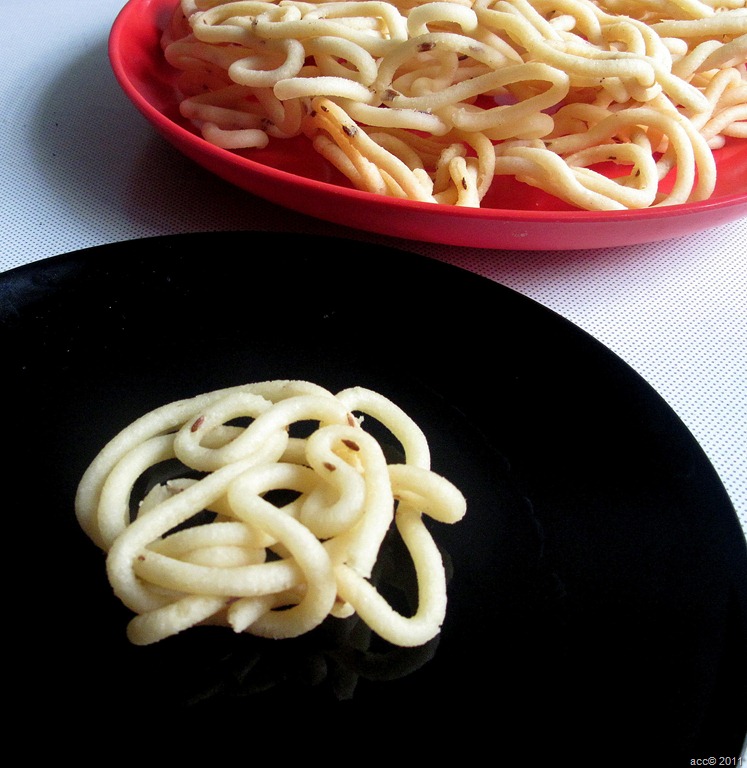
“””PLEASE HAVE A LOOK AT THE “POINTS TO REMEMBER” BEFORE STARTING..”””Thenkuzhal

Thenkuzhal murukku


Thenkuzhal murukku White thenkuzhal murukku for Diwali !
Cuisine: Indian
Category: Savories
Serves: 25 nos
Prep time: 15 Minutes
Cook time: 20 Minutes
Total time: 35 Minutes


INGREDIENTS
1 cup - 200ml
  • Raw rice/Maavu arisi - 5 cups
  • Round urad dal - 3/4 cup
  • Fried gram dal/Pottukadalai - 1/4 cup
  • Butter – 4-5 tbsp (1/4 cup)
  • Asafetida / hing – 1/2 tsp
  • Jeera / cumin seeds or Black sesame seeds – 2 tbsp
  • Salt & water – As needed.
  • Cooking oil – for deep frying.
For small quantity : 1 cup = 250ml
  • Rice flour - 1 cup
  • Roasted urad dal flour -  2 tbsp
  • Butter - 1 tbsp
  • Hing - 2 pinches
  • Cumin seeds or sesame seeds - 1 tsp
  • Salt & water - as needed
  • Cooking oil - to deep fry
METHOD

  • Heat a kadai and dry roast urad dal slightly without changing its colour. Roast till nice aroma comes from urad dal. Switch off the flame and add the fried gram dal. Now mix the rice, roasted urad dal and fried gram dal. Grind in flour mill or powder it in mixie. If u use mixie to grind the mixture, please don’t forget to sieve the flour. Flour should be very fine in texture. This is called “murukku maavu”. If you have store bought readymade murukku maavu,u can use it. OR u can use store bought rice flour and make urad dal flour at home.
  • Melt butter and set aside.
thenkuzhal
  • To this murukku maavu,add salt ,melted butter, hing , jeera or sesame seeds and water to make a non sticky dough. Take the murukku press and mould with one whole. Fill the dough and set aside..
thenkuzhal-recipe
  • Heat the oil in a broad kadai and and press the murukku in circular motion directly in oil or press the murukku in a polythene sheet or in the back of ladle separately and then drop in hot oil. This way u get a nice shape. If the string gets cut while pressing, either urad dal flour is less or water is less.So add 1 tsp more urad dal flour and drizzle some water, mix well and try it.  After u press the murukku , please stand a few feet away from the kadai.Sometimes , very rarely murukku may burst like seedai . If it doesn’t burst, then proceed.
thenkuzhal-recipe-1
  • Cook for sometime.Flip and cook for some more time till the hiss sound and bubbles ceases .Do it in medium flame.Adjust the flame whenever needed. Remove and drain in a paper towel..Store in an air tight container after it cools down.

thenkuzhal-recipe-2

Don’t forget to try the half cooked murukku in the last batch.For this, after u press the murukku in oil , just flip immediately and remove in 10 secs.. Eat it hot !!
White colored , crispy thenkuzhal is ready to enjoy !!
Note
  • When u make murukku in large quantities , make the dough in batches to avoid the dough from drying.Also cover the dough with a damp cloth or a lid while cooking murukku. This helps in getting white colored murukku for all the batches. Otherwise color may vary for the last batches.
  • We have added fried gram dal and butter to get the crispness & white color . But usually fried gram dal is not added in thenkuzhal.Its purely optional.
  • Adding too much of butter makes the murukku look oily and becomes soggy very soon.Shelf life gets reduced.
  • Adding more urad dal flour or too much of roasting the urad dal results in dark colored murukku.So make sure u roast the urad dal without changing the color..
  • If u use store bought rice flour and urad dal flour , the ratio would be 8:1.No need to roast the urad dal flour if it is ready made.
  • The murukku flour should be very fine in texture otherwise it may burst while cooking. So i always sieve the flour for safer side Winking smile
  • Use enough oil for deep frying. Add more oil after few batches if necessary.
  • Drop or press the murukku only when the oil becomes hot. U can find this by dropping a pinch of flour. It rises up quickly.This is the correct heating point. Do not let the oil fume. Always keep the flame in medium for even cooking.
  • Instead of pressing in oil directly , u can try pressing it in the back of ladle greased with oil or greased polythene sheets. This way u’ll get nice shape.. 
  • After cooking when u break the murukku , u can c a hole in the middle of the murukku like  funnel. This denotes the murukku is perfect !!
Perfect thenkuzhal must form a hole.Can u see the hole in the broken murukku piece Winking smile
Thenkuzhal-murukku
Catch u in my next post. Bye. Have a gr8 weekend Smile

الخميس، 1 ديسمبر 2011

November Indian Vegetarian Recipe Roundup

My regular readers will know how much I adore Indian cuisine, even though I am not of Indian descent myself. So for November, I invited readers to submit one of their favourite Indian recipes, with a randomly drawn winner from the entrants receiving a free copy of 660 Curries by Raghavan Iyer. This book is a treasury of wonderful Indian recipes from traditional to modern and fusion styles, suitable for beginners and experienced cooks alike, and is used constantly as a reference in my kitchen.

A very special thanks to all who submitted their recipes. I have shelves full of cookbooks but, as far as I am concerned, one can never have enough inspiration in the kitchen. And here are the submissions:


Up first is Lisa of We Don't Eat Anything with a Face. Paneer, mushrooms, spices, chickpeas, coconut and nuts and vegetables are all included in her dish. How could I resist this Paneer and Vegetable Tikka Masala?


Janet of The Taste Space is up next this mouthwatering Indian Eggplant and Lentil Curry (Dal Bhat Meets Baingan Bharta). Though roasting the eggplants created a lot of smoke, this one-dish meal was certainly worth the trouble and effort.


Divya of Dil Se has me craving dinner right now with a Mushroom Biryani. Spicy too, this will not fail to please mushroom lovers like myself.


From Claudine of The Kathmanduo we have this delicious Channa Masala Hummus. I love hummus, and this inventive Indian-style take on it has my tummy rumbling.


Privish of Killer on the Plate offers up this most tempting Spicy Stuffed Okra dish. This is a vegetable I need to make more often. Such a lovely presentation too.


Nayna of Simply Food submits one of my all-time favorite Indian dishes, Dal Makhani. Creamy, healthy, rich in protein and packed full of flavour, everyone should try a dal makhani at some time.


From Adam and Theresa of Keen on Food we have this gorgeous and very tempting Stuffed Eggplant Poriyal adapted, I was happy to hear, from one of my favourite cookbooks. I can never resist South Indian recipes, and this reminds me that I need to explore eggplant more often.


Tangy and spicy, this beautiful Spicy Dahi Aloo, or potatoes cooked in yogurt, from Laavanya of Cookery Corner won't fail to please fans of Indian cuisine. And I don't know anyone who doesn't love potatoes.

mattar paneer

My contribution for this event is another one of my all-time favourites, and an Indian classic. Mattar Paneer is a staple dish in any home that serves Indian food, and when I go out for dinner this is also one of my favourite menu choices.


Akheela of Torviewtoronto treats us to this Ivy Gourd Stir Fry. I've yet to try ivy gourds — small Indian summer squashes — but this would be a great place to start.


Now here is a Millet Bread from Vaishali of Ribbons to Pastas. Green chutney is of course an essential condiment to go along with this Leele Doongri ne Kadhi ane Rotlo. This innovative creation surely tempts my palate.


Geetha of Sun Moon and Tomatoes presents this lovely Kappa Curry (Tapioca in Roasted Coconut Sauce) inspired by her mom. This South Indian dish is sure to please your palate.


From Richa of Hobby and More, here is a delicious vegan and gluten-free Kaju Katli, or Indian Cashew Fudge. A perfect treat to share with friends and family to celebrate this month's Indian festivals.


Deepika of My Life and Spice certainly has my mouth watering for this Nargisi Kofta. Another beautiful dish, Deepika certainly dresses this one up. The spice mixture sounds just divine. Stuffing a paneer or chenna cheese shell with raisins and apricots is a brilliant idea.


Paneer cheese is one of my favourite foods, so how could I resist this Butter Paneer Masala from Reeta of mykaleidoscope. This is also one of my favourite restaurant dishes, but so much better when homemade in your own kitchen.


Here we have another paneer dish from Val of More Than Burnt Toast. I made Saag Paneer myself recently, and it is always a favourite. I am so happy that I inspired this dear woman to learn more about Indian cooking.


Another one of my favorites from Sweatha of Tasty Curry Leaf. A winter warmer indeed, you will have to try this Mulligatawny Soup. Adapted from another of my favourite cookbooks, this is a curry-flavoured soup from South India similar to South Indian rasams. Yum.


Sundried Tomato Chutney from Usha of Veg Inspirations. Wonderful flavours, and pictures of pretty flowers as well. I do so love sundried tomatoes and what a great creation. I am craving this just right now.


Usha of My Spicy Kitchen presents an Okra Stir Fry that will not fail to please us vegetarians. Simple and easy but surely not lacking in flavor, this is a dish I would enjoy anytime of year.


Sweet Soma of eCurry presents this tempting Pan-Fried Cauliflower with Yogurt and Soy Sauce. Inspired by her Grandmother, this Indian fusion Chinese dish is sure to please and it is easy to prepare. Wholesome and creative.


Lynds of Vanilla Clouds and Lemon Drops offers up some gorgeous Spicy Chickpea Fritters. Certainly the best Indian food is made at home and I can't wait to try this dish.


Priya of Easy N Tasty Recipes never fails to please. This one-pot meal of Soya Chickpeas Dumplings & Tomato Pulao will most certainly please and nourish hungry tummies. The possibilities are endless.


Oh, more paneer! Mansi of Fun & Food Cafe has me craving this Kaju (Cashew) Paneer Masala. You can never go wrong with cooking with paneer, in my opinion, and your dinner guests will never be disappointed — that is for sure.

Thank you again to all my readers who submitted these fantastic Indian recipes. I hope everyone finds something here to try.