‏إظهار الرسائل ذات التسميات HOW TOs. إظهار كافة الرسائل

الأحد، 8 يناير 2017

How To Celebrate Thiruvathirai At Home/ Arudhra Darshan


Significance of Arudra darshan
Soure:wiki and google
Thiruvathirai/Arudhra darshan is a popular Hindu festival celebrated in Tamil Nadu and Kerala.
Arudhra Darshan or Arudara Darshan is observed in the Tamil month of Margazhi (December – January) on Thiruvathirai Nakshathram day. In this year 2017, it falls on January 11th,Wednesday ( tomorrow). It is essentially a Shaivite festival and celebrates the cosmic dance of Lord Shiva, which is represented by the Nataraja form. Arudra festival is celebrated with fervor in Lord Shiva temples in Tamil Nadu, Sri Lanka, Singapore, Malaysia, South Africa, Australia and in other parts of the world by Tamil speaking population. In Kerala, this festival is primarily celebrated for women.The most important Arudhra Darisanam festival takes place at the Chidambaram Lord Nataraja Temple in Tamil Nadu. Arudhra signifies the golden red flame and Shiva performs in the form of this red-flamed light.The cosmic dance of Lord Shiva represents five activities – Creation, Protection, Destruction, Embodiment and Release. In essence, it represents the continuous cycle of creation and destruction.Arudra Darshan celebrates this ecstatic dance of Lord Shiva.
It takes place on the full moon night in the month of Margazhi and this is also the longest night in a year. The festival is mainly observed in the Tamil speaking world.As per the Puranaas, on this day Lord Shiva has shown this blissful dance that energizes this world to two of his devotees - Vyagrapadha and Adisesha (on whom Lord Vishnu Reside). Hence this day is celebrated, in appreciation of the cosmic dance of Lord Shiva, by offering Prayers to the Nataraja aspect of the Lord.
Special prayers are held on the day at all Shiva temples. Milk, honey, water, sandal paste and other cooling liquids are offered to Lord Shiva on this day. This is to cool a burning and turbulent Shiva who is performing the Tandava – the cosmic dance of Nataraja.Special abhishekam, rituals and celebrations are held on the night of Thiruvathirai.

Celebration in my house :)

Our Celebration

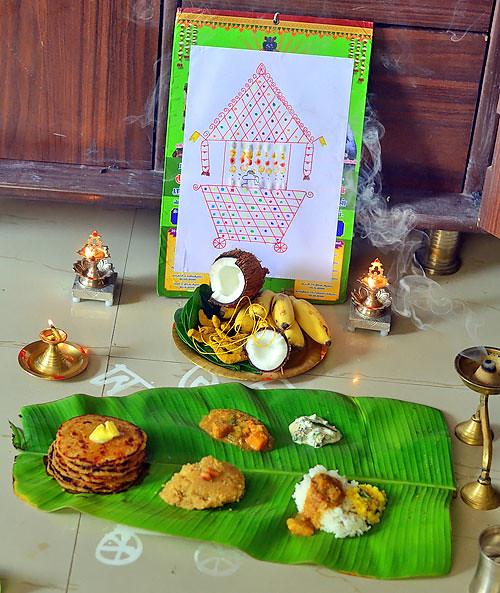
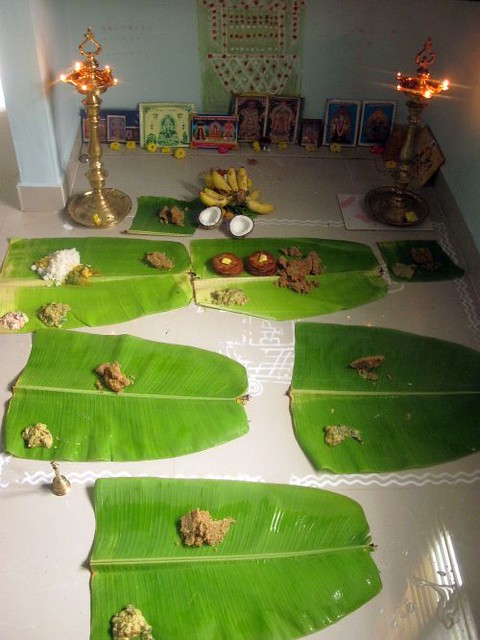
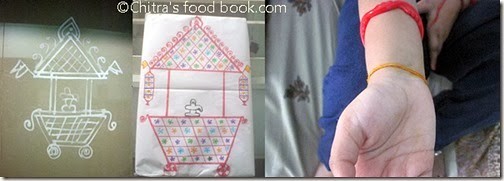
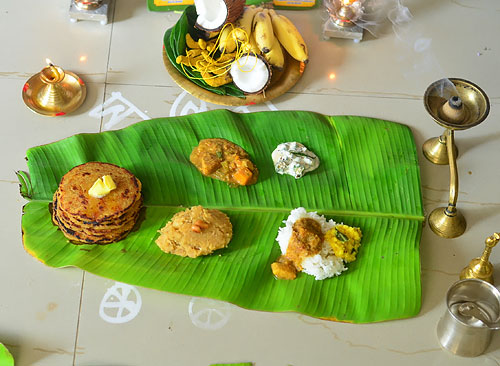
In our house, we celebrate this festival in a grand manner by offering kali, ezhu kai kootu and adai made of rice flour and jaggery to Lord Nataraja. We also draw maakolam all over our house. My MIL draws a procession car(Thaer) with Shiva lingam in the wall of pooja room and consider it as idol.We tie a yellow rope in our hands after pooja. I have shared our pooja procedures in detail . Please check it. You can follow/alter this method based on your tradition.

How to celebrate thiruvathirai
Celebration in my MIL's house :)

How to celebrate thiruvathirai


Ingredients Required

Please CLICK THIS LINK for Thiruvathirai Adai, Kali and kootu recipes.

Thiruvathirai kali recipe with video

Visit my in-laws blog LEARN KOLAM for Thiruvathirai Kolam
  • Raw rice
  • Moong dal
  • Jaggery
  • Rice flour
  • Cardamom powder
  • Grated coconut
  • Ghee
  • Butter
  • Any 7 vegetables ( Raw banana, sweet potato, yam, pumpkin, broad beans, arbi, field beans, brinjal, chow chow, cluster beans, ladies finger)
  • Green chilli
  • Cumin seeds
  • Coconut oil
  • Tempering ingredients for kootu
For Pooja
  • Coconut
  • Betel leaves and nuts ( 7 each)
  • Fruits ( 7 banana)
  • Banana leaves ( 7 leaves)
  • Turmeric pieces ( 7 nos)
  • Yellow rope ( to tie around wrist or neck)
  • Lamp, wick
  • Incense stick, camphor
Thiruvathirai celebration

Pre Preparatory activities
The previous day, clean the house. Wash the lamps, put the wick. Keep turmeric, kumkum dots & make it ready for the next day neivedyam. We have the practice of drawing procession car ( thear) in the wall of pooja room as shown in the first picture and in the entrance of house. We draw maa kolam in the house entrance and in pooja room. As mine is a wooden pooja room shelf, I draw in a paper & keep it as GOD and I draw maakolam at the house entrance alone.We keep 7 dots using viboodhi, manjal, kumkum, sandal, kajal( Kanmai), red saandhu , rice flour in the middle of thear picture for this nonbu. We keep 7 betel leaves, 7 nuts, 7 banana, 7 turmeric pieces, 2 yellow ropes (for me & my daughter) in a plate & keep in front of God.All these things are time consuming jobs.So we do it the previous day night & keep them ready. If you don’t have this practice at home, just do the pooja by keeping a Lord Nataraja or Lord Shiva photo in the auspicious time.
We make kali, 7 kai kootu, adai, cooked rice, thayir pachadi, dal/paruppu and sambar for neivedyam. So we do some pre-preparatory works for cooking as well. We roast rice + dal, powder & keep it for kali. We chop the vegetables for kootu & sambar and refrigerate it in a box.
Thiruvathirai day 
On Festival day, we should do the pooja in the early morning in auspicious time. This year as it falls on Wednesday, we should do the pooja before 7.30am ( Avoid rahu kalam, yama kandam). So start the cooking activities by 6 am. Prepare thirivathirai kali, adai & kootu ( Rice, dal, sambar, thayir pachadi). Decorate the pooja room with flowers and light the lamp. Arrange all the neivedyam dishes in the banana leaf. Keep a plate with banana, coconut, betel leaf and nut, turmeric pieces along with yellow rope. Do the pooja by showing dhoop, dheep and mangala harathi. After doing the pooja, tie the yellow rope around your wrist or neck.
Enjoy kali, kootu and adai !!
DISCLAIMER : The pooja procedures I have shared above is as per my family’s practice. Many people don’t have the habit of drawing thear, maakolam, offering adai. Even my mom makes kali and kootu for thiruvathirai and offers them in front of Lord Nataraja picture for pooja. So take this post as a guidance and change it according to your custom.


الاثنين، 26 سبتمبر 2016

Cooking Tips For Working Women – Indian Cooking Ideas

Cooking tips for working women
Friends, this post is all about useful cooking tips for Indian working women, beginners in cooking, bachelors, stay at home moms with babies in hand and for house wives who wish to finish the morning chores quickly and easily without any tension .These pre-preparation ideas would help you feel relaxed and manage to do quick and easy cooking during the busy, hectic weekdays. Recent days I have been getting mails to share some simple lunch menu ideas for busy weekdays by spending less time in kitchen. Very soon I will start a lunch menu series suggesting some easy and healthy Indian lunch recipes for daily cooking. Before that, I wanted to make a post about useful cooking tips & pre preparations to make the job easier. As I have worked for an year after marriage, I have seen & heard from my colleagues about the difficulties in managing home and career.Time management plays a major role here. For me, there was no problem at all as I was in a joint family. My in-laws did all the household chores and supported us very well.In this present day nuclear family setup, many people does not get the luxury of moral & physical support of elders to share cooking and other household responsibilities. So it would be really tiresome and stressful if we don’t plan things ahead. I hope these simple, handy tips and tricks would  be helpful to make the kitchen chores easier and stress freeHappy. Don’t worry, these pre-preparations won’t eat your weekend’s relaxing hours. You may need to spend just 2-3 hours to finish all these works or you can get the help of your servant maid to finish this job quickly. This will save lot of time during busy weekdays. Before going to this post, I must thank my friend Shalini for helping me to frame these points as she is regularly following these things.Love you lots dear Love Struck. She also shared some pictures from her kitchen. I have made them as a collage and given below. Friends, I hope this post would be useful to plan & manage things easier. Working women and bachelors, please share your valuable tips you follow in your daily cooking in the comments section. It would be of great help for the people who read this post. Thanks in advanceHappy. Ok, now lets see some smart cooking tips and secrets to be a super wife and momWinking.This post is with more & more of stories and essays. Please bear with meTongue.

DISCLAIMER : All the points I have shared below is based on the ideas I got from my working friends. I have also gone through some websites and magazines for more tips. Please modify or skip the suggestions as per your wish & need. You need to have a refrigerator, pressure cooker and some good air tight containers to make & store the dishes.

Cooking tips for working women Indian

SOME USEFUL GADGETS

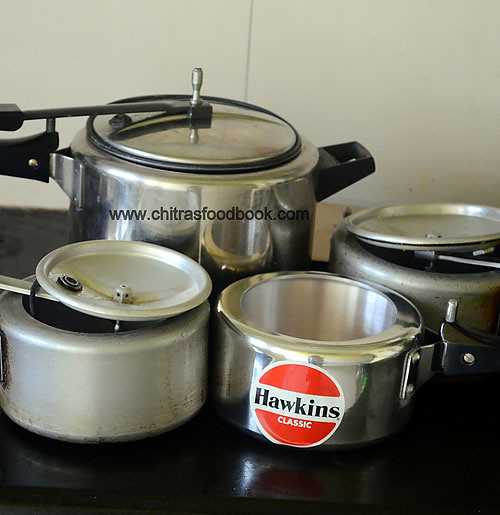
According to me a 2 burner gas stove, 3 small pressure cookers, few ladles, mixing bowl and a mixer grinder is enough to cook even for 10 people. Pressure cooker is my biggest strength. It helps to cook any food quickly and easily. I have shared the pictures of  my cookers above for your reference.I use 3 Hawkins small sized pressure cookers ( 1.5 liters and 2 liters) and one 5 liter cooker. I use 2 of them for lunch preparation and 1 for cooking breakfast. I use the big sized cooker only for my guest. I will share how I use these cookers for quick cooking in my upcoming lunch menu series.

Cooking tips for working women - Indian
Pic courtesy – My friend Shalini
PLAN AHEAD

Make a weekly timetable for the menu according to your family's preferences. Keep a list of all the dishes you want to cook in the following week and write down all the required ingredients so that you can purchase all the groceries and vegetables as per the list.If you don’t like to spend time in grocery shopping, go for a monthly purchase. Refer my “Monthly Grocery list” post for the idea. You can buy vegetables once in 10 days and store them in refrigerator.  I follow this every month to save my time spent in shopping.

GRIND THE BATTER

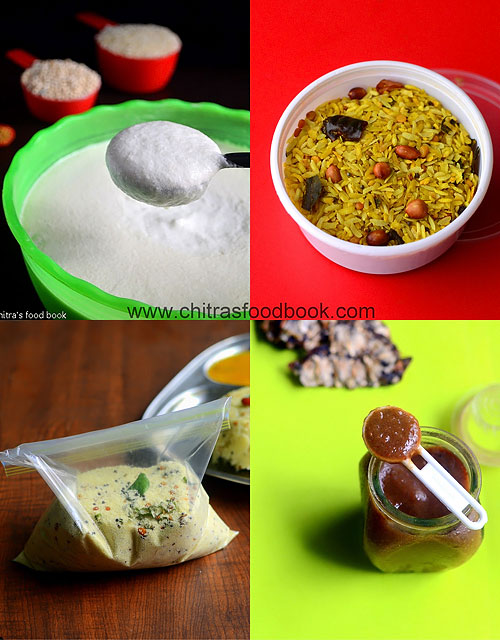
This point is especially for people who rely on Idli dosa recipes. Grind Idli dosa batter, Appam batter, Adai batter during weekend and store it for a week. You can even make millet idli, dosa batter and store it for one day. Idli, dosa batter is a real savior in Indian cooking. You can make idli, dosa, uthappam, Paniyaram for breakfast and dinner as well. Similarly you can also grind and keep batter for dosa varieties like Set dosa, sponge dosa, poha dosa etc. It will help you for sure. My friend Shalini's maid helps her to grind varieties of idli and dosa batters during every Sunday for the whole week's use. Even though I am a house wife, I too grind all the batters during weekends and use it mainly for the week's breakfast because I don't want to hit my head thinking about breakfast recipes during busy morning hours. Generally I make Instant dosa varieties, Instant idli varieties like oats idli, rava idli, upma recipes like wheat rava upma, vegetable rava kichdi, millet recipes, Ragi roti, Phulka or stuffed paratha varieties for my dinner. I try to avoid consuming rice at night.
Check out my Idli varieties post for varieties of idli,dosa batter. Check out my easy dosa batter recipe too ! For other options, you can make instant dosa varieties, upma varieties for breakfast or dinner.

MAKE ROTI DOUGH

Make roti dough well in advance and refrigerate it. The kneaded dough will remain fresh for at least 2-3 days. You can make use of this dough for making roti , poori and stuffed paratha. Remember to store in an air tight box. Take only the required quantity of dough from the box and immediately refrigerate the leftover dough.  But try to use it within 3 days.

PREPARE THE SIDE DISHES

When we have idli, dosa batter in our hand, we start to hit our head for making side dishes. That’s quite natural. So prepare some side dishes like tomato thokku without onion, tomato thokku with onion, onion tomato chutney, garlic chutney, Raw onion chutney, Idli Podi/Gun powdergreen chutney without coconut based on your preference and store in an air tight box. It will stay good for a week. You can use these chutneys as side dish for idli, dosa, appam and roti or use it as sandwich spread too. I usually make onion tomato chutney and stock it for my daughter’s breakfast and lunch box. For roti, you can prepare side dishes like capsicum-tomato curry, tomato thokku, pickles and even jam for your kids.  You can even cook Dal for making dal tadka or dal curry and refrigerate for 3 days. If you love to have pasta, you can make white sauce & pasta sauce ahead and store them.

Check out my 50 chutney recipes for more ideas.

For quick lunch, you can prepare and store Pulikachal paste/Puliyogare paste, Lemon rice paste, coriander thokku, thogayal varieties, Vathakuzhambu paste and podi/powder varieties like Dal powder/Paruppu podi, Dhania/coriander seeds powder, Angaya podi, Sundakkai podi, Poondu podi/Garlic powder, coconut podi etc.

Kuzhambu varieties like vatha kuzhambu, poondu kuzhambu, milagu kuzhambu, kara kuzhambu, tomato gravy, brinjal gravy stays good for even 2 -3 days with or without refrigeration. So you can make them once or twice in a week apart from sambar and rasam.
Check out my 30+ kuzhambu varieties post to get the links for the above recipes.

READYMADE BREAKFAST MIX

Roast rava and keep in bulk. It will help you to make upma quickly. You can also make Rava/sooji upma mix, Poha mix, pongal mix, rice upma mix in advance and store in the freezer. It helps you to make your breakfast or dinner quickly and easily. Always keep a packet of bread in stock for making quick sandwich or toast.

CHOP THE VEGETABLES AND FREEZE

Vegetables like carrot, beans, peas, cauliflower, sweet corn, cluster beans, spinach, broad beans can be diced or chopped & frozen for a week.If you want to use the vegetable for the next day morning, you can simply refrigerate the chopped veggies. Do not freeze them. Usually I keep frozen peas and frozen corn always in stock. Grate 2 coconuts and store 3/4th of the quantity in a zip lock cover.Deep freeze it. Store the remaining coconut in refrigerator. Just thaw it for few minutes before use or use warm water to grind the coconut. Take the required quantity of coconut, refrigerate it and keep the remaining in freezer immediately. De-stem coriander, curry leaves and mint leaves and store in an air tight box. Mostly I use palak leaves during weekdays as it is easy for cleaning, chopping and cooking. During weekends, I buy other greens/Keerai varieties, clean them and store in a ziplock cover.Do not chop onions and store. It attracts more bacteria when its cut.
Apart from chopping veggies, you can make some lemon juice and store in a glass bottle, peel garlic cloves, Peel &finely chop ginger, peel small onions and keep them ready for usage. But remember to store the chopped vegetables in a clean zip lock cover and refrigerate.

COOK PUREES, PASTE & LENTILSCook toor dal or moong dal in large quantity and store in a box for 2-3 days use. You can use them and make sambar instantly. Soak beans like rajma,dried peas and chana for 8 hours and refrigerate them for later use. You can easily cook a quick meal like pulao,  biryani or gravies & even make a healthy salad with it. Sprout green gram and other legumes based on your liking and keep them in the freezer. So whenever you want to have some salad, you can semi cook and have them ready.
Grind and keep tomato puree, homemade tamarind paste, ginger-garlic paste, onion paste, sauce varieties ready in hand. You can also keep some readymade seasoning, green chilli paste.Some people keep some sauteed, browned onions too. I have seen some of my friends making onion-tomato puree adding masala powders and keep the base ready for making North Indian gravies. If you have enough time in hand, you can even make two to three varieties of curries and refrigerate them.
Vegetables like potato, cauliflower, sweet corn and peas can be boiled in advance and refrigerated for later use. You can even cook pasta and store them in the fridge.
Keep curd, buttermilk, paneer, cheese and other essential milk products ready in hand so that you can use it for raita, buttermilk/ Chaas, lassi, gravies and sandwich.

TO DO LIST
I have summarized the above points and shared a TO-DO list for weekend. Do this according to your preference and time in hand.
  1. Grind idli, dosa batter and other batters if grinding.
  2. Make chapathi/ roti dough.
  3. Soak pulses & lentils like rajma, chana/ kabuli, peas.
  4. Chop all the required vegetables. Make frozen peas and sweet corn.
  5. De stem green leaves/Spinach, coriander leaves, mint leaves and curry leaves.
  6. Cook toor dal and moong dal in large quantity for making sambar & dal for roti.
  7. Make Tamarind paste, Tomato puree, Puliyogare paste, Tomato thokku, homemade powders like dal powder, curry leaves powder, coriander leaves thokku, thogayal varieties, Lemon rice mix, Chutney varieties according to your choice. ( I have shared the links in the above sections. please check it)
  8. Make white sauce and pasta sauce for cooking pasta recipes.
  9. Prepare rava/sooji upma mix, poha mix, dosa mix, pongal mix.
  10. Make onion tomato base for North Indian gravies.
  11. Purchase week’s grocery and vegetables.
  12. House cleaning if needed Happy.
Friends,I  hope this post will be helpful to you. Thanks for visiting this page !!

الاثنين، 19 سبتمبر 2016

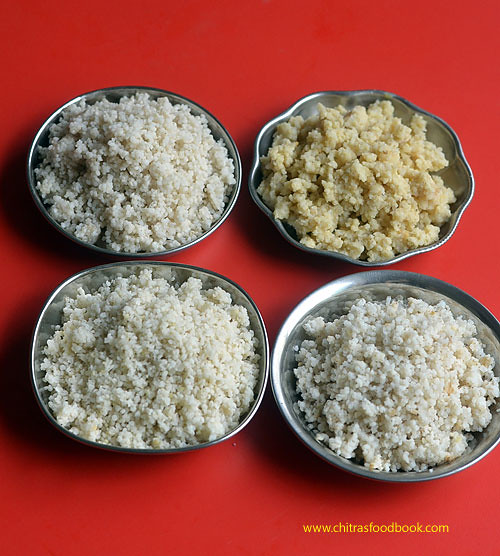
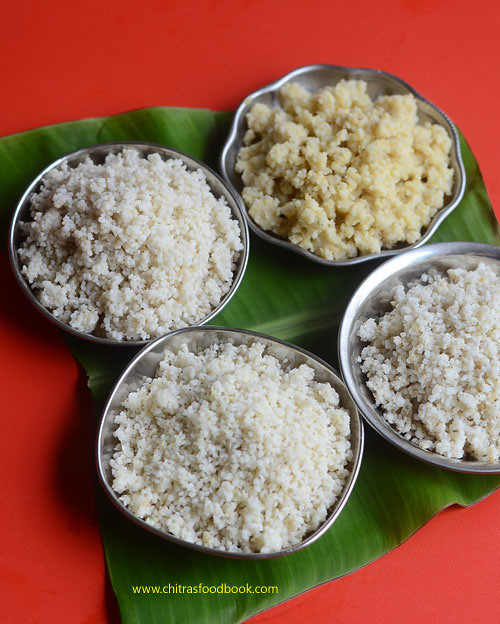
How To Cook Millets – Thinai, Varagu, Samai, Kuthiraivali, Kambu

How to cook millets 
After a long time, I am making a post about Millets (Sirudhaniyam in Tamil). As we all know, Millets are a super healthy grain with loads of fiber, calcium, minerals & iron.People have started switching to millets and include it in their regular cooking as a replacement of rice for breakfast, dinner and lunch as well. Millet rice can be cooked on stove top( In a open pan), in a rice cooker, pressure cooker and even in microwave just like normal rice. But most of us are not sure about how to cook millet  perfectly in a fluffy way like pulao, biryani or for making Indian style recipes like Pongal, upma, porridge, koozh with a mushy texture. Its always confusing about the water ratio for different types of millet like Varagu arisi (Kodo millet), Samai (Little millet), Kuthiraivali (Barnyard millet), Thinai rice (Foxtail millet) and Kambu (Pearl millet). I have not discussed about Quinoa in this post. Quinoa and thinai are different millets.I will make a post on that separately. So in this post, I have shared how to cook Indian millet in 3 different ways i.e Open pan method, In a pressure cooker and in an electric rice cooker. Water quantity may vary based on the quality of millet. Some millet may need less water and some may need more. So please keep this post as a reference and do the trial and errorHappy .
Warning about millets
I would like to emphasize this point before going to this post. Even though, Millet is a super healthy food, one should consume it moderately based on their body. Over consumption may lead to indigestion, stomach bloating, loss of appetite, imbalanced thyroid levels. So please include different types of millet in your diet thrice or 4 times in a week. Do not consume the same millet repeatedly. Try to include varieties of millet in your cooking. I have heard people consuming millet for all the 3 times in their daily food just for weight loss by completely avoiding rice. Recently I read in an article that Millets would slow down the thyroid activity. So moderate consumption is advised for people with thyroid problems. In general ” Too much of anything is good for nothing”. So please consume it in moderate quantity and reap all it benefits. Maintain a healthy life style. This is my kind advice based on my own experience Happy.
For people who are new to millet, please check my “All about millet” post for a better understanding. 
How to cook millets in pressure cooker

Millets names in different languages

ENGLISH – Finger millet, Kodo millet, Pearl millet, Barnyard millet, Little millet, Foxtail millet
HINDI - Nachani /mundua, Koden/Kodra, Bajra, Jhangora, Kutki, Kangni/Rala 
TAMIL – Ragi, Varagu, Kambu, Kuthiraivali, Samai, Thinai
KANNADA – Ragi, Harka, Sajje, Oodalu, Saame, Navane
TELUGU – Ragula, Arikelu, Sajjalu, Odalu, Sama, Korra
MALAYALAM – Panjipullu, Koovaragu, Kambam, Kavada pullul, Chama, Thina

How to cook millets in different ways

How to cook millets in different ways

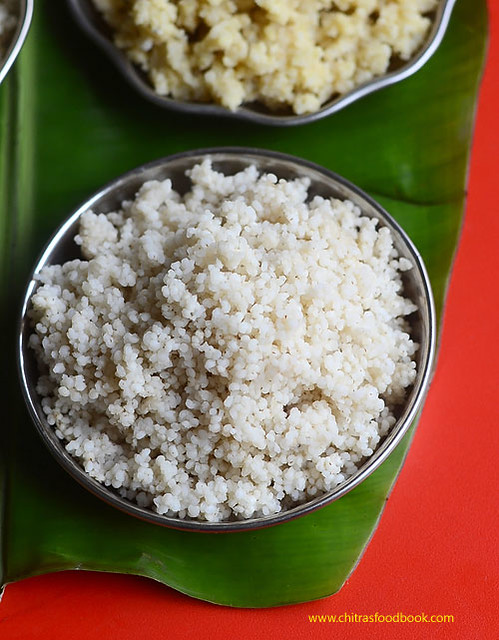
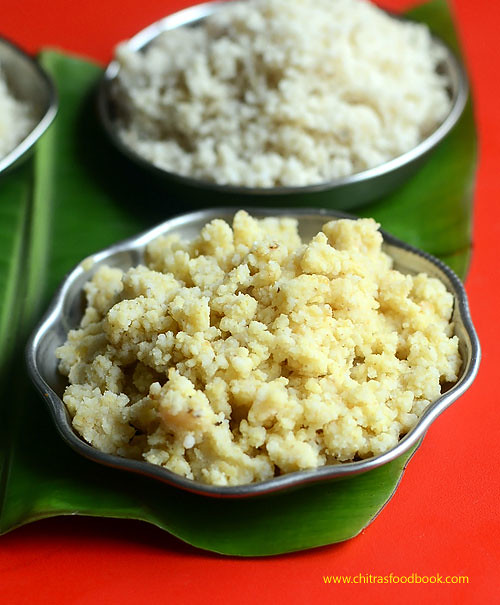
How to cook Millet


How to cook Millet How to cook different types of millet - Thinai rice, varagu rice,samai, kuthiravali and kambu
Cuisine: Indian
Category: Millet Recipes
Serves: Serves 2
Prep time: 5-30 Minutes
Cook time: 10 Minutes
Total time: 15-40 Minutes


INGREDIENTS
1 cup - 200ml
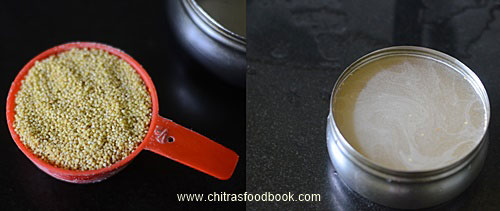
  • Varagu arisi (Kodo millet), Samai arisi (Little millet), Kuthiraivali ( Barnyard millet) - 1/2 cup
  • Water – 1.25 cups to 1.5 cups ( 1:2.5 to 1:3 ratio)
  • Cooking oil - few drops (optional)
For thinai & kambu, water quantity may vary. Soaking is needed.
  • Thinai rice( Foxtail millet) - 1/2 cup
  • Water - 1.5 cups
  • Kambu / Pearl millet – 1/2 cup
  • Water – 2 cups
For making pongal, bisibelebath, thick porridge : use 1: 5 ratio of millet & water and use pressure cooker.
For making pulao, biryani : use 1:2 or 1: 2.5 ratio of millet and water. It is better to cook in open pan to get fluffy rice.
METHOD

  • Try to buy unpolished millet because its healthier than polished ones. Wash the millet at least twice or thrice.Use a strainer or metal sieve with fine holes to filter it. Some millet may contain husk, dust particles or even small stones. So wash it well.
    HOW TO COOK VARAGU, SAMAI AND KUTHIRAVALI 
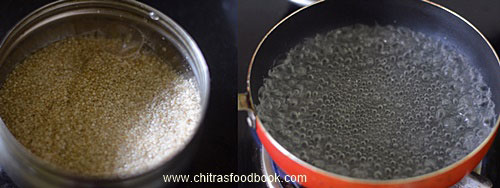
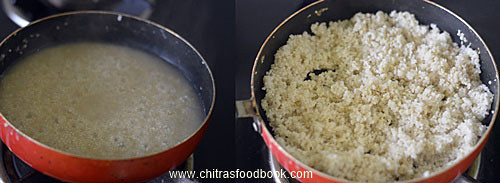
  • In Open pan : For 1/2 cup of varagu arisi, measure 1.25 cups of water ( 1:2.5 ratio). No need to soak in water. Heat water in a pan. When it starts to roll boil, simmer the flame completely.
 
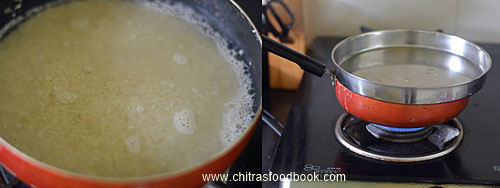
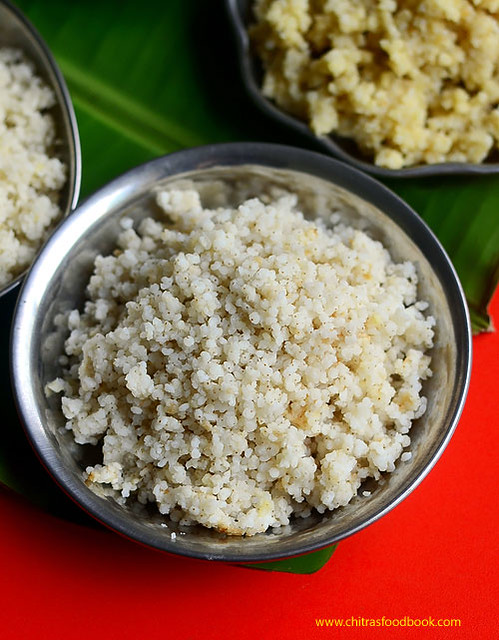
  • Add the washed and drained millet to the  boiling water. Lower the flame completely. Cover with a lid & cook for 5-7 minutes. Fluff it gently once in the middle using a fork. Cook till all the water is absorbed. Switch off the flame and keep it covered for 10 minutes.
  • It will get cooked in the resting time and becomes fluffy.After 10 minutes, you can remove it and serve with any sambar or any kuzhambu OR use it for making variety rice. Enjoy !
How to cook in rice cooker : Wash 1/2 cup of millet and drain the excess water. Boil 1.5 cups of water and add the millet ( 1:3 ratio). Cook it till the lights turn to warm mode. Open the cooker & check if its cooked well. If not, add 1/2 cup more water and cook for some more time.
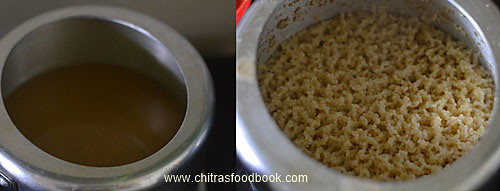
How to cook in Pressure cooker : For cooking in pressure cooker, wash the millet and drain the excess water. Heat a cooker base with 3 cups of water. In a cooker vessel, take 1/2 cup of varagu/ kodo millet, Kuthiravali/ barnyard millet and add 1.25 cups of water (1:2.5 ratio) . For Samai/ Little millet, add 1 cup of water ( 1:2 ratio). Add few drops of cooking oil if you need fluffy rice. Cover with the lid and pressure cook in very low flame for 2 whistles. Make sure flame should be the minimum. It takes nearly 5-7 minutes to cook. If not, cook for 5 minutes in low flame and switch off the flame. DO NOT COOK the millet directly in a cooker base. It may lead to burnt bottom layer. So its better and safe to cook millets by placing them inside a vessel.
If you are making pulao or biryani, you can directly cook it with spices and vegetables. In that case, add 1:2.5 water and keep an eye. Switch off after cooking for 6-7 minutes in very low flame. Open the cooker after the steam is released.
HOW TO COOK THINAI/ FOXTAIL MILLET
  • In a open pan : Wash the foxtail millet twice to remove the dust. Soak it for minimum 30 minutes. For 1/2 cup of thinai/ foxtail millet, heat 1.5 cups of water. When the water starts to roll boil, add the soaked thinai. Mix well and add a few drops of cooking oil. Cover and cook till all the water is absorbed. Toss it once or twice in the middle. Actually thinai takes long time to cook than other millets. So keep checking for the water content and add 1/4 cup more only if needed.
  • In a rice cooker : Wash 1/2 cup of foxtail millet and drain the excess water.Soak it for an hour. Boil 1.5 cups of water and add the millet. Cook it till the lights turn to warm mode. Open the cooker & check if its cooked well. If not, add 1/2 cup more water and cook for some more time. How to cook in Pressure cooker : For cooking in pressure cooker, wash the millet and drain the excess water. Heat a cooker base with 1.5 cups of water for 1/2 cup of thinai. Let the water roll boil. Add the washed millet, few drops of cooking oil and mix well. Cover with the lid and pressure cook in very low flame just for one whistle. Make sure flame should be the minimum. It takes nearly 5-7 minutes to cook. If not, cook for 5 minutes in low flame and switch off the flame. Cooking for longer time burns the bottom layer. So keep an eye.
How to cook thinai
How to cook thinai
  • HOW TO COOK KAMBU/ PEARL MILLET : Wash the kambu well. Soak in water for 30 minutes. Drain the excess water and spread in a cloth. Let it dry for 5 minutes. Grind it coarsely in a mixie to remove the husk. Sieve it well. Boil 2 cups of water for 1 cup of kambu. When the water starts to roll boil, add the kambu, mix well without lumps and cook till all the water is absorbed. Cover & cook it. Kambu cannot be cooked fluffy. It comes out mushy in texture.
  • In pressure cooker : Take 3 cups of water in a pressure cooker for 1 cup of kambu. Cook for one whistle in low flame or 3 whistles in medium flame.
Enjoy with sambar, kootu and poriyal !
How to cook millet


Note
  • The quantity of water may vary. +/- 1/2 cup difference may be there.
  • Cooking time may vary for the cooker and open pan method. So keep an eye if you are cooking for the first time.

MILLET RECIPES


السبت، 10 سبتمبر 2016

Onam Sadya Recipes – Kerala Onam Sadhya Vibhavangal/ Lunch Menu

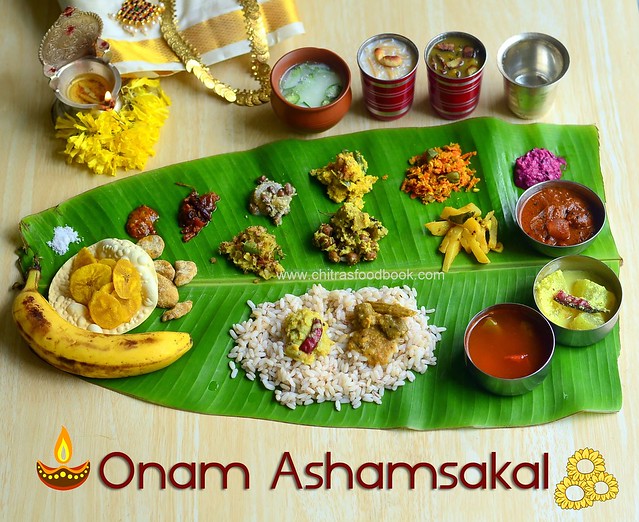
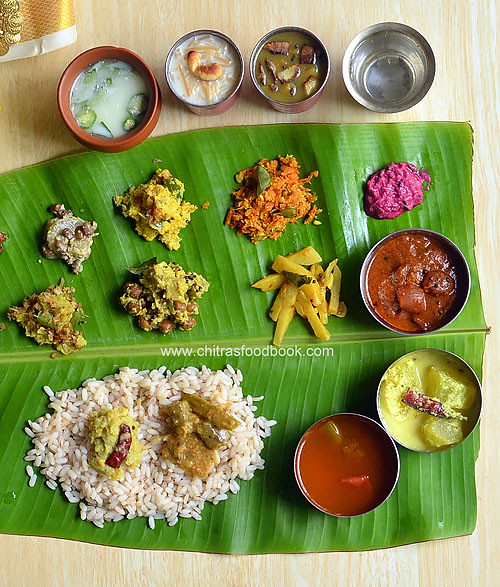
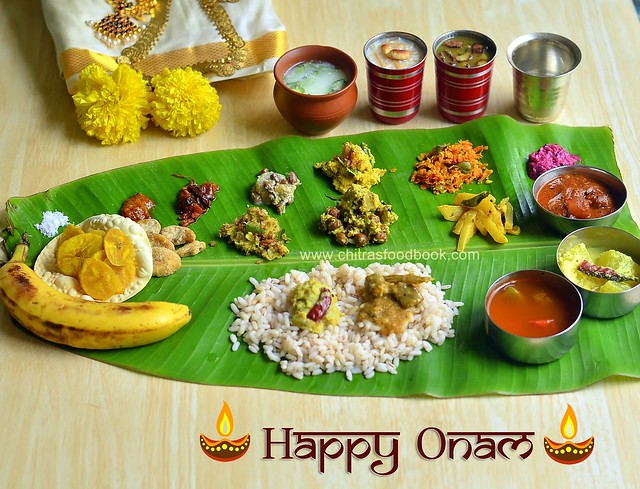
I am extremely happy and proud to share my 5th Onam sadya lunch menu with you allHappy.Since 2012, I have been sharing varieties of Onasadhya feast during ThiruOnam festival. Every year I used to attempt some new, authentic Kerala dishes in my Onam sadya. I take this as a chance to learn many Kerala recipes and to express my passion for their food. Moreover Sendhil and myself loves to have feast and treat ourselves with Kerala delicacies.Initially I started with a simple Onam sadhya menu in 2012. Later I started making around 15-20 dishes for the onam feast every year. Onam sadya preparation is the one and only thing that makes me busy in my kitchen and cook continuously for 3-4 hoursWinking. Pre Planning and organization is very important to cook a sadhya. So I have shared Onam sadya items list, how to prepare easily, Onam sadya serving order etc according to my knowledge and experience. Please excuse me and correct me if there is anything wrongPraying. Most of the dishes are tried from our fellow food bloggers of Kerala. I have given the links for each recipes. I hope this post would help you plan and prepare Kerala Onam sadya easily and quickly. Lets see how to prepare Onam sadya lunch menu in detail.
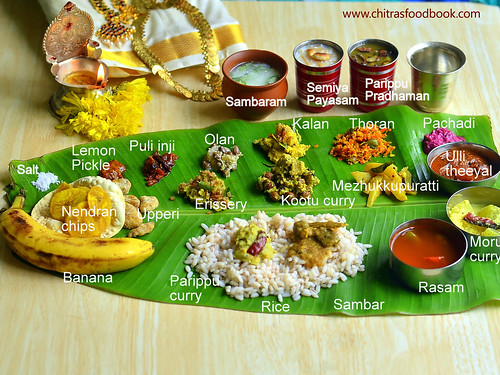
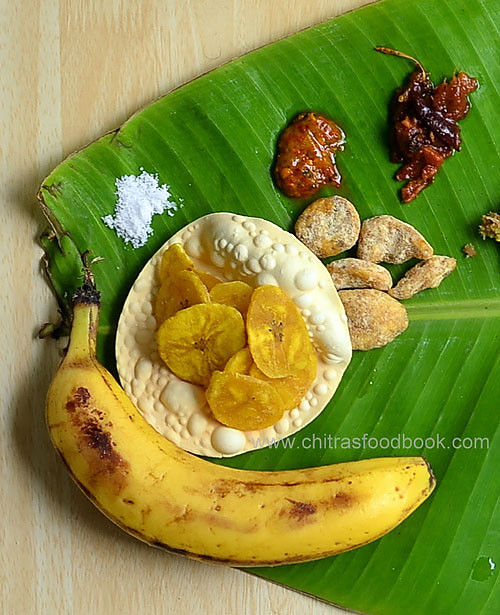
Onasadya Serving order : From tip of banana leaf : Salt, Papadam, Nendran banana, chips, upperi, Puli inji, Pickle, Olan, Kalan, Erissery, Puliserry, Avial, Kootu curry, Thoran, Mezhukkupuratti, Pachadi, Kichadi. In the center of leaf : Rice, Parippu curry, ghee, Sambar, Moru curry, ulli theeyal, rasam, Sambaram, Parippu pradhama, Payasam varieties on the top corner. Refer image below.
Onam sadya serving order
Wish all my readers and friends a very happy Onam.”ONAM ASHAMSAKAL” !!
How to prepare onam sadya

Onam sadya Recipes - Kerala Lunch Menu


Onam sadya recipes Onam sadya lunch menu recipes - Kerala Onam vibhavangal
Cuisine: Kerala
Category: Onam sadya
Serves: Serves 2-3
Prep time: 60 Minutes
Cook time: 180 Minutes
Total time: 4 hours


INGREDIENTS
Onam sadya items list for cooking
  • Vegetables I used for this menu ( Yam, Raw banana, Drumstick, Ash gourd/Kumbalanga, Carrot, Potato, Beetroot ) for thoran, Mezhukkupuratti, Pachadi, Olan, Kalan, Kootu curry, erissery, moru curry, sambar
  • Small onions
  • Ginger for Puli inji
  • Moong dal for Parippu curry
  • Curry leaves
  • Tamarind
  • Red chillies
  • Green chillies
  • Cumin seeds
  • Brown chana
  • Black eyed peas/Cow peas
  • Coconut oil
  • Coconut
  • Banana
  • Nendran banana
  • Moong dal for Parippu pradhaman
  • Jaggery
  • Semiya for semiya payasam
  • Sugar
  • Coconut milk
  • Cardamom seeds
  • Dry ginger powder
  • Papad
  • Salt & water
  • Sour Curd for moru curry
  • Buttermilk for Sambaram
  • Mustard seeds + Urad dal + Red chilli - For tempering
Onam sadya recipes with links
Side dishes
Payasam recipes
Sambaram

Other recipes ideas for menu
Onam Sadya menu
METHOD
  • Plan the menu, buy the vegetables and other items one day before Onam. Soak the tamarind for sambar, rasam and brown Chana( Kadala) overnight.
    • In the morning, after taking bath, start cooking. Soak the Ada in water for 30 minutes if you are making ada pradhaman.
    • I used 2-3 cookers of 3 liter capacity for making this menu.
  • Last year when I made sadya,I noticed that most of my time was spent in pre preparatory works like grating coconut, extracting coconut milk, grinding masala, chopping vegetables and for cooking dals & vegetables.This year I wanted to make all these works simple and easy. So instead of grating 2 coconuts, I made small slices of it using a ladle edge with thick & blunt handle as u see in the picture.Make sure your mixie blades are in good condition else it may break.Then I dry ground all the coconut slices together and divided them into 2 parts.I used one part for taking coconut milk and the other part for masala.It saved lot of time for me. Take the required amount of coconut for each dish. Most of the dishes call for grinding coconut +green chilli+ jeera to a smooth paste. So grind it by taking a portion of coconut.Keep it and use wherever needed.Use the remaining coconut for taking coconut milk.Add in payasam.
    How to prepare onam sadya
  • To this mashed dal ,Also I dry roasted the moong dal for parippu curry and pressure cooked it along with toor dal for sambar together in my big pressure cooker by placing moong dal in the bottom of cooker and toor dal for sambar in a tiffin box.Please refer the picture.U can even keep a plate of mixed vegetables required for sambar over the toor dal. When the dals are cooking, You can chop the vegetables for sambar, avial or kootu curry, olan, Pulisssery, pachadi, kichadi & inji curry.By this time,steam would be released from the cooker.Remove the toor dal box and mash the dal well.Similarly mash the moong dal too.Add little ground coconut paste and boil well. Parippu curry is ready.
    How to prepare onam sadya
  • For cooking Vanpayar and vegetables for olan,kalan and erissery, i again used my big cooker and cooked them together by keeping one above the other in small bowls and plates.As all these veggies gets cooked in one go,u just have to add them in coconut mixture and boil it.For thoran, I cooked it in my small cooker adding very less water and cooked in high flame for two whistles.
    How to prepare onam sadya
  • After removing this,cook the red rice adding 1:12 water and drain the excess water.Keep the rice aside. Make sambar, rasam and other dishes. Make the payasam at the end using the cookers ! It takes nearly 2-3 hours.
Disclaimer: I know these are not the authentic method of cooking Kerala food but to make my job easier, I followed these steps and I hope it would help beginners.Friends,please excuse me Happy.
I have planned to make  few posts for the above mentioned recipes with stepwise pictures. Sorry I couldn’t do it now.Thanks for visiting this page. Hope u will try all these recipes and like it.Once again,I wish u all a very happy Onam. Enjoy the feast!
Onam sadya items
Make a grand Onam spread on Festival day and enjoy with your family members.
Wish you all a very happy Onam Star
Onam sadya recipes

الثلاثاء، 30 أغسطس 2016

Ganesh Chaturthi – Pooja Procedure/Puja Vidhi/ Vidhanam

Ganesh chaturthi pooja vidhanam
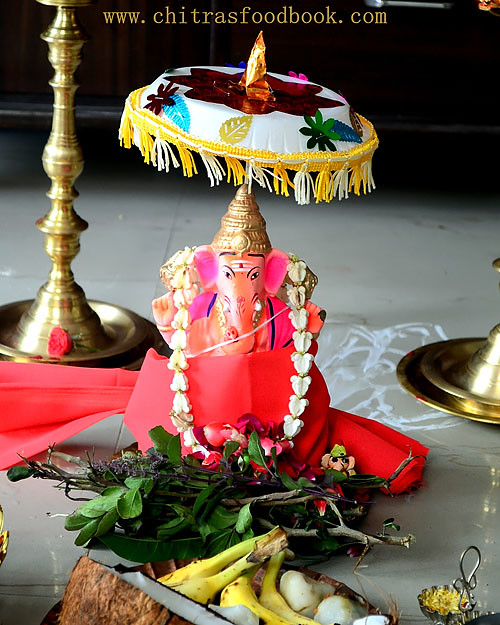
Last year I made a post on with details about Abishekam things, pooja items along with its procedures and Ganesh chaturthi recipes links. But it is purely based on my family’s tradition and practice. Some people have the practice of keeping Kalasha & Gouri on this day. Recently one of my readers requested me to share Ganesh Chaturthi Pooja Vidhanam/Puja vidhi along with mantras just like my Varalakshmi Vratham pooja post. So I referred my book “Avanai maadha Pooja Vidhanam” ( My friend Shalini’s gift) and shared the slokhas, detailed pooja method with pictures and Ganesha story in PDF format ( you can see at the end of post) to help people who wish to celebrate Ganesh chaturthi pooja in an authentic way. I have shared pooja vidhanam in Tamil. So I have mentioned some useful links for pooja vidhi in Sanskrit, Hindi, Telugu and Kannada at the end of the post. Hope you find them useful.
Ganesh Chaturthi festival is celebrated as the birthday of Lord Ganesha.He is the first worshipped God before any holy puja or occasion.This year 2016, Vinayagar Chaturthi festival falls on September-5th, Monday. This festival is also known as 'Vinayak Chaturthi' or 'Vinayaka Chavithi' .It is observed during the Hindu month of Bhadra in Hindi /Avani in Tamil (mid-August to mid-September). For more information on Ganesh chaturthi festival, click this link
.
Click this Video on how to make Homemade Ganesh using Kozhukattai dough.

For Ganesh chaturthi Kolam/Rangoli designs, please Visit my in-laws blog for Learn kolam.

Disclaimer : The pictures and pooja procedures I shared in this post are from a devotional book gifted by my friend. This is just one of the ways of celebration. It may vary from place to place. Please consult the elders in your family and follow your tradition.Beginners can follow this if you don’t have any specific procedure at home. Thanks for visiting this page.
How to celebrate Ganesh chaturthi at home


Ingredients 

List for Abishekam, pooja & neivedyam
  • Ganesh idol

  • Wooden plank or peeta to place Ganesha

  • Flowers

  • Milk

  • Curd

  • Honey

  • Tender coconut water

  • Water

  • Rice flour

  • Sesame oil

  • Turmeric powder

  • Shikakai powder

  • Kumkum,Sandal paste

  • Panchamirtham (Curd based delicacy consisting of Panch(5) items: Milk, Sugar, Ghee (clarified butter), Honey, Bananas)  Some items are not shown in pic.

    Ganesh chaturthi pooja


    For Decoration & pooja

    • Vastram for Ganesha ( New blouse bit or dhoti cloth)

    • Mupiri nool for poonool ( 3 threaded string)

    • ArugamPul (Bermuda grass (English). Arugampul (Tamil), Dhub (Hindi), Durva (Sanskrit). Karuka (Malayalam), Garikagoddi (Telugu), Garikoihallu (Kannada))

    • Tulsi leaves ( Its allowed only on this day)

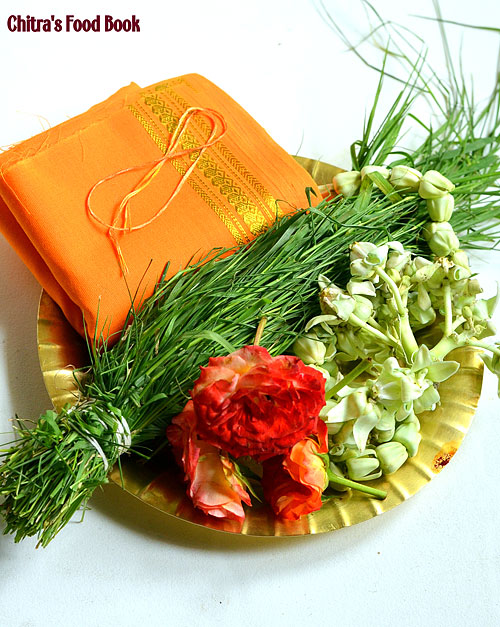
    • Vellerukku Malai ( White flower garland, refer the above picture)

    • Yellow rice/Akshathai

    • Flowers

    • Kumkum & Sandal powder

    • Incense stick

    • Camphor

    • Sesame oil & ghee for lamp

    • Fruits,coconut,betel leaves & betel nut for offering

    • Banana leaf

    • Turmeric powder for manjal pillayar

        For Neivedyam recipes
        Click THIS LINK for Neivedyam recipes collection.

    • Coconut

    • Jaggery

    • Chana dal/Moong dal

    • Sugar

    • Besan

    • Urad dal

    • Green chillies,ginger,salt ( for pooran)

    • Raw rice for payasam

    • Urad dal for vada

    • Wheat flour,banana & jaggery for appam

    • Sesame seeds for ellu urundai

    • Click HERE to see the no onion no garlic lunch menu cooking with ingredients

    how to celebrate ganesh chaturthi
    Abhishekam Orderhow to celebrate ganesh chaturthi

    Benefits of Abhishekam
    PANCHAGAVYAM - Removes all sins of mankind
    PANCHAMRUTHAM - Gives wealth
    GHEE- Gives Moksha state
    MILK - Gives long life
    CURD - Gives Good Children
    HONEY - Melodious voice
    RICE POWDER - Frees from debts
    SUGAR CANE JUICE - Gives good health and removes enmity
    LIME JUICE - Removes fear of death
    TENDER COCONUT JUICE - Gives enjoyment and full satisfaction in life
    SANDAL PASTE - Gives Lakshmi's Grace
    SUGAR - Removes enmity
    Source : http://www.teluguone.com/devotional/content/what-are-things-used-in-shiva-abhishekam-its-effects-56-27598.html#sthash.kCQAROkq.dpuf
    how to celebrate ganesh chaturthi

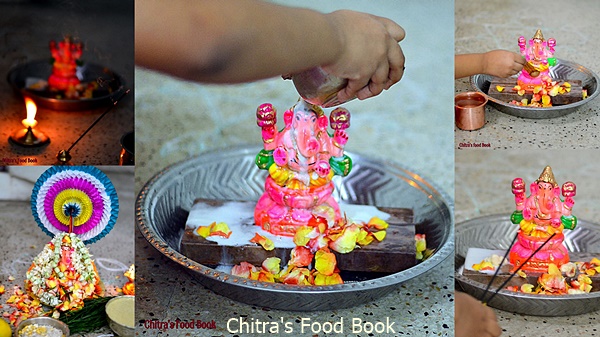
    Abhishekam should be done by the elders of the family. In our house, my daughter sits with my husband and do the abhishekam :)  Refer the above picture. If you are having Ganesha made of Turmeric powder, soft clay or Kozhukattai dough, pour water and other abhishekam items only in spoons else Ganesha will dissolve in water.

    You can chant this Ganesha Gayathri mantram while doing Abhishekam.
    Om Tatpurushaya Vidmahe Vakratundaya dheemahi, Tanno Danti Prachodayat”

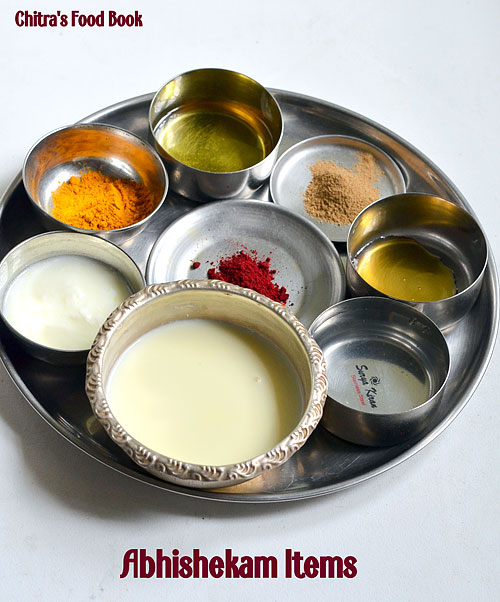
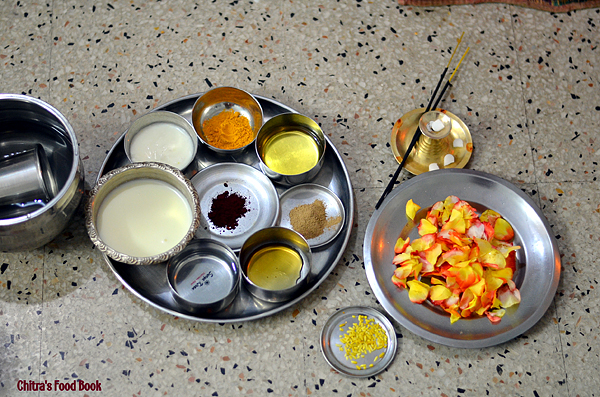
    Draw Kolam/Rangoli on where you are going to do the pooja.Take all the abhishekham items in a plate as shown in the picture. Keep a bowl full of water.Keep some flowers in a plate. Keep an incense stick and a camphor ready.Take a wide plate ( thambaalam). Place a wooden plank inside it and keep the Ganesh idol. Start the abhishekam by putting some flowers and few drops of water. Before doing abhishekam,keep this mind. Ganesh idol should not fall down during abhishekam. So do not pour more water. Touch the idol carefully with support. First do the sesame oil abhishekam, then apply shikakai powder.Wash it well by adding water.Then apply turmeric powder, light the incense stick and show the dhoop & dheep. Mix rice flour in water and do the abhishekam.Then comes milk, lemon juice, tender coconut water, curd, panchamirtham followed by honey. Collect the panchamirtham with honey in a plate.Pour some water and then continue with sandal paste, Kumkum and lastly viboodhi abhishekam. Finish the abhishekam with little milk.Show the dheep. Pour water and start to decorate the Ganesh. Collect all the abhishekam water in the wide plate and pour in tulsi plant or under some trees.


    Lord Ganesha Decoration
    Wipe the idol with a clean cloth. Put a poonool / Mupiri nool(3 threaded string) from left to right keeping Ganesha facing towards you. Then wear a new cloth for the idol. Decorate with Tulsi leaves (Generally Tulsi should not be used to decorate Ganesha. But it is allowed only on this day.) Vellerukku malai, arugampul malai and flowers. After abhishekam & decoration,start doing the pooja.

    How to do pooja
    Check out this PDF for detailed pooja stotras in Tamil. Please download it and follow the directions.
    Before you start the pooja, keep lots of flowers, leaves and Arugampul in a plate. Make a small cone shaped pillayar/Ganesh with turmeric powder and keep a kumkum dot. Keep a small bowl full of Panchamirtham and a spoonful of honey in a bowl.
    If you are placing Kalash, It should be placed firmly on a Copper/Silver plate with rice spread on it. A Coconut is placed over the mouth of the Kalash. Five mango leaves are placed inside the kalash before placing the coconut (like a skirting).
    The decorated Ganesha Idol can be placed above on a table/stool and the Kalasha and its plate can be placed in the ground. Light the lamp on the sides of Ganesha. Keep the small turmeric Ganesha( made of turmeric powder mixed with little water) nearby the idol. Keep kumkum & flowers. Place a plate with 5 types of fruits, broken coconut, betel leaves & nuts in front of the God.
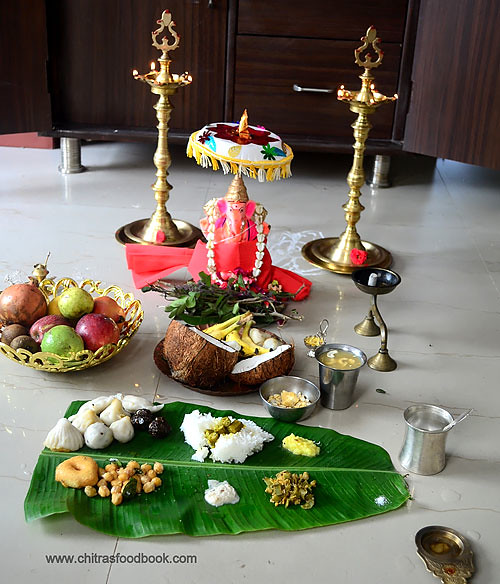
    In another plate or banana leaf,spread the neivdeyam recipes. Kozhukattai varieties comes to the left side of Ganesha. Rice and other items has to be kept in the usual order. Refer picture for the idea. Keep payasam and aval.pori kadalai/Puffed rice with peanuts in small bowls. Start doing the pooja.
    For any pooja, Poorvanga pooja is considered as Pradhana pooja. So keep the turmeric Ganesha before the Ganesh idol and start the poorvanga pooja mantra. Check out this PDF for detailed pooja stotras with method in Tamil. Please download it and follow the directions. For complete Puja vidhi in Hindi, Tamil, English, Kannada, Telugu and Malayalam, Please refer THIS LINKFinish the pooja with mangala aarti !

    Ganesha Chaturthi pooja vidhi with mantras in sanskrit / english
     http://www.drikpanchang.com/festivals/ganesh-chaturthi/ganesha-chaturthi-puja-vidhi.html
    Please use http://www.virtualvinodh.com/aksharamkh/aksharamukha2.php to transliterate the mantras to your script (tamil / telugu / kannada ) from Devanagari.


    Siddhi Vinayaka Ashtottara sata namavali  in other languages


    Sanskrit -  http://sanskritdocuments.org/doc_ganesha/vinaayaka108-5.html?lang=sa
    Tamil -  http://sanskritdocuments.org/doc_ganesha/vinaayaka108-5.html?lang=ta
    Telugu -  http://sanskritdocuments.org/doc_ganesha/vinaayaka108-5.html?lang=te
    English - IAST - http://sanskritdocuments.org/doc_ganesha/ganesha108.html?lang=iast

    AUDIO,VIDEO LINKS FOR OTHER LANGUAGES
    • Click this LINK for Pooja Vidhanam Audio in Telugu
    • Check this LINK , LINKfor Pooja Vidhanam Audio in Tamil
    • For Hindi version,check this youtube video LINK
     After celebration procedures ( Visarjanam)

    On Chaturthi evening, make wheat flour appam and do the neivedyam.The next day morning, you can keep idli for neivedyam or simply fruits would do. On afternoon,keep dal & rice with ghee for neivedyam. Continue this neivedyam till Ganesha stays in your house.The next day or the third day, take the ganesha idol along with flowers & vastram,some puffed rice,jaggery and fried gram dal(Do not remove anything from idol) and put it in water.Let the Ganesh idol dissolve  in water and take away all the misfortunes of people.
      Click THIS LINK for Neivedyam recipes collection.
    ganesh chaturthi pooja vidhanam

    Neivedyam Recipes


    Please click this LINK for full collection of neivedyam recipes.This is the LINK for Kozhukattai making Videos & Homemade Ganesh idol using rice flour dough.

    Disclaimer : The pictures and pooja procedures I shared in this post are from a devotional book gifted by my friend. This is just one of the ways of celebration. It may vary from place to place. Please consult the elders in your family and follow your tradition.Beginners can follow this if you don’t have any specific procedure at home. Thanks for visiting this page.
    Wish you all a very happy Ganesh chaturthi ! Happy
    Thanks for visiting this page !